Isometric (static) exercises
· 2 min
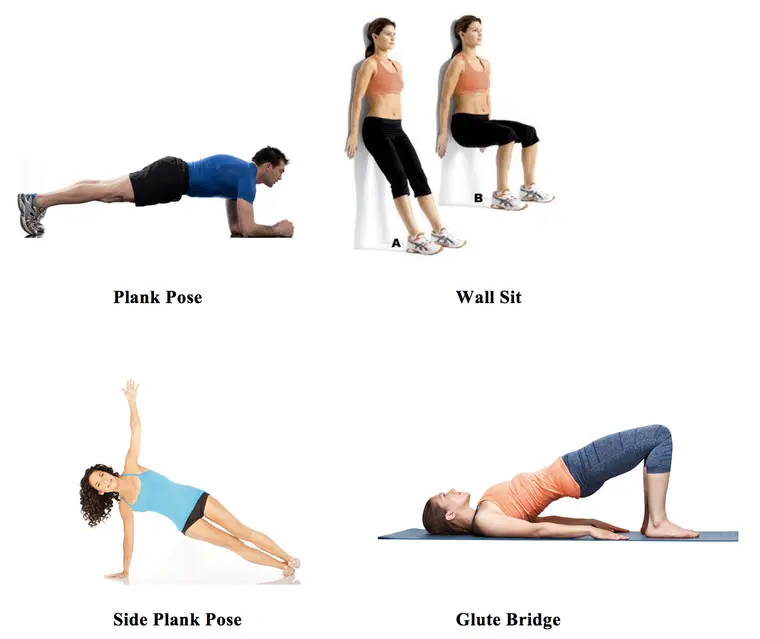
Isometric exercises are a form of strength work in which a muscle contracts without any movement at the joint. In this mode the muscle length does not change, yet the muscle fibers generate high tension.
For example, when we lift a dumbbell, the biceps shortens — this is dynamic (isotonic) work. But if the elbow is bent and we hold the dumbbell still, the biceps contracts without changing length — this is the isometric mode. The best-known isometric exercise for the abs is the plank.
Isometric vs. dynamic exercises
In dynamic exercise the muscle length changes, and maximal tension lasts only briefly (a matter of seconds). In isometric exercise high tension can be sustained for 6–12 seconds or longer.
Research shows that isometric exercises
- are effective for building strength
- increase neuromuscular activation
- develop strength especially well at a specific joint angle
However, it should be noted that
- for increasing muscle size (hypertrophy),
isometric training is no better than dynamic training - strength gains occur mainly at the angle where the weight is held.
Physiological features
During isometric contraction
- intramuscular pressure rises
- capillary blood flow is temporarily restricted
- anaerobic metabolism increases
Energy is spent on maintaining muscle tension rather than on movement. This creates a strong neuromuscular stimulus but does not improve coordination or speed.
Types of isometric exercises
Isometric exercises fall into 3 main groups:
1. Pushing against an immovable resistance
(for example, trying to lift a barbell that cannot be moved)
2. Static holds during a movement
(pausing for a few seconds at a specific point in the range of motion)
3. Working with maximal weights
The initial phase is dynamic, the main phase is static
(holding the barbell 10–15 cm from the start of the movement)
Key isometric exercises
- Bench press
- Deadlift
- Squat
Barbell position options
Bench press
- Low — bottom position
- Middle — halfway up
- High — 3–5 cm short of lockout
Deadlift
- Low — knee level
- Middle — thighs
- High — waist level
Squat
- High — knees slightly bent
- Middle — half squat
- Low — full squat
If only one exercise is performed, the middle position is recommended.
Load and timing
- Duration of tension:
- short — 6 seconds
- medium — 9 seconds
- long — 12 seconds
- Rest: 45–60 seconds
- Total workout duration: 15–20 minutes
Tips for beginners
- Start with holds of up to 6 seconds
- Do not use maximal effort at the initial stage
- Do not hold your breath
- Breathing should be controlled and rhythmic
Once you are better prepared, you can progress to 9–12-second holds.
The role of isometric exercises in a training program
Isometric exercises
- increase maximal strength
- strengthen weak positions
- are effective during a “plateau”
However, they cannot replace dynamic exercises, which develop:
- speed
- coordination
- elasticity
- movement technique
👉 The best results come from properly combining isometric and dynamic exercises.
📛 Author: Irakli Kenchoshvili / Tidanigym.ge
Copying without permission is prohibited.
✅ Sharing is permitted with credit to the source
Got a question? Message or call us
Tidani + is a gym at 4 Politkovskaya St., 300 m from the metro. Mon–Fri 09–22, Sat–Sun 09–18.