Glute muscles: structure and function
· 2 min
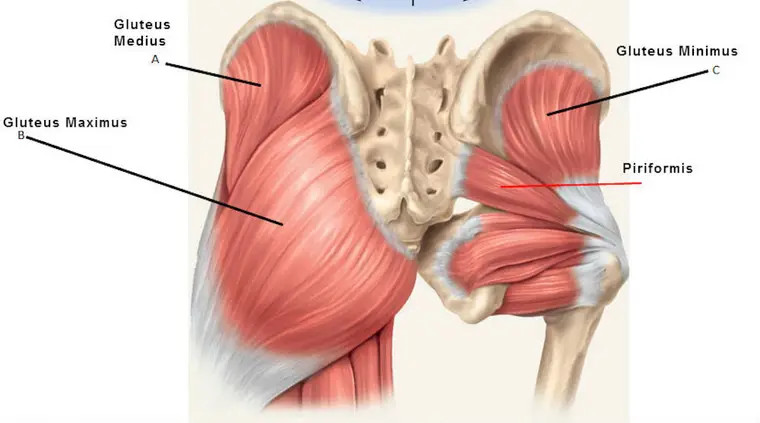
The glutes are one of the strongest and most functionally important muscle groups of the pelvis. They play a major role in movement, body stabilisation and generating force in the lower limbs.
The gluteal group consists of three main muscles:
- gluteus maximus
- gluteus medius
- gluteus minimus
Gluteus maximus
The gluteus maximus is one of the strongest muscles in the human body.
It originates from
- the posterior part of the ilium
- the sacrum
- the coccyx
and inserts into
- the femur
Main functions
- hip extension
- external rotation of the hip
- straightening the torso from a forward-bent position
- stabilising the pelvis during walking and running
Functionally, it is often divided into
upper fibres, which are more involved in hip abduction;
lower fibres, which are more active during hip extension.
➤ Activation during training
The gluteus maximus is especially active during hip extension movements.
Knee position is an important factor
- With the knees bent (e.g. in a glute bridge), the hamstrings are less involved and more of the load shifts to the glutes.
- With straight legs (e.g. in a Romanian deadlift), the hamstrings work harder.
Effective exercises
- glute bridge
- hyperextension
- cable kickback
- deep barbell squat
- plié squat
- Bulgarian split squat
- machine leg press
- reverse hack squat
The glute bridge is especially good at isolating the glutes when the knee angle is about 60–90°.
Gluteus medius
The gluteus medius sits at the upper part of the gluteus maximus and is partly visible from the side of the body.
Developing it visually
- widens the sides of the hips
- creates a more defined shape
- makes the waist look narrower
Functions
- hip abduction
- stabilising the pelvis during walking
- contributing to internal and external rotation of the hip
Effective exercises
- banded lateral walks
- standing side leg raises
- prone hip abduction on a bench
- cable hip abduction
- machine hip abduction
Leaning forward during hip abduction increases the hip's range of motion and often boosts glute activation.
Gluteus minimus
The gluteus minimus is the deepest layer of the gluteal muscles and lies beneath the gluteus medius.
It is practically invisible from the outside, but it plays an important role in stabilising movement.
Functions
- hip abduction
- stabilising the pelvis during walking
- contributing to internal rotation of the hip
Developing it helps improve the overall volume and shape of the glutes.
Muscle fibre type and training principles
According to research, the glutes contain both
- slow-twitch (Type I)
- and fast-twitch (Type II) fibres
This combination of muscle fibres means that different types of loading can be effective.
In practice, what works well for hypertrophy is
8–15 reps per set
Training recommendations
For well-rounded glute development, it is important to use
- a variety of movements
- both heavy compound lifts and isolation exercises
Optimal volume
- 2 workouts per week
- 3–6 sets per session for each muscle group
This supports both strength gains and muscle hypertrophy.
Author: Irakli Kenchoshvili / Tidanigym.ge
Copying without permission is prohibited.
✅ Sharing is welcome with a link to the source
Got a question? Message or call us
Tidani + is a gym at 4 Politkovskaya St., 300 m from the metro. Mon–Fri 09–22, Sat–Sun 09–18.