Structure of the abdominal muscles
· 2 min
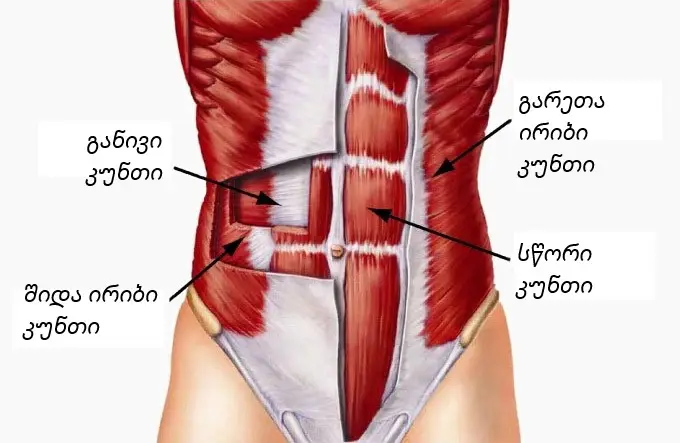
The abdominal muscles form the abdominal wall and play an important role in body movement, breathing, protecting the internal organs and regulating intra-abdominal pressure. Anatomically, they are divided into the muscles of the anterior, posterior and lateral abdominal walls.
Muscles of the anterior abdominal wall
The anterior abdominal wall includes
- Rectus abdominis – involved in bending the trunk forward, stabilising the pelvis and increasing intra-abdominal pressure. This is the so-called “six-pack”, the most visible of the abdominal muscles.
- Pyramidalis – a small muscle that tenses the linea alba; it is not developed in everyone.
Muscle of the posterior abdominal wall
The posterior abdominal wall includes
- Quadratus lumborum – located at the back of the abdomen; it is involved in side-bending of the lumbar spine, stabilising the trunk and assisting breathing (when the rib is fixed).
Muscles of the lateral abdominal wall
The muscles of the lateral abdominal wall are arranged in three layers:
- External oblique – the most superficial layer; involved in rotating and side-bending the trunk.
- Internal oblique – involved in trunk rotation and stabilising the abdominal wall.
- Transversus abdominis – the deepest layer; plays a key role in controlling intra-abdominal pressure, stabilising the lower back and supporting the internal organs.
⚠️ It is important to note that these muscles do not directly “slim” the waist; rather, their tone and control of intra-abdominal pressure visually create a tighter, more stable corset.
➤ Functions of the abdominal muscles
The main functions of the abdominal muscles are
- stabilising and moving the spinal column (flexion, rotation, side-bending);
- taking part in breathing together with the diaphragm;
- regulating intra-abdominal pressure;
- holding the internal organs in place and protecting them;
- taking part in urination, defecation and childbirth.
When the abdominal muscles contract, the volume of the abdominal cavity decreases and intra-abdominal pressure rises, which assists these physiological processes. This is why the muscles of the abdominal wall are often called the abdominal press muscles.
Author: Irakli Kenchoshvili / Tidanigym.ge
Copying without permission is prohibited.
✅ Sharing with a link to the source is welcome
Got a question? Message or call us
Tidani + is a gym at 4 Politkovskaya St., 300 m from the metro. Mon–Fri 09–22, Sat–Sun 09–18.