Amino acids and proteins: protein structure and functions
· 2 min
Proteins make up about 50–80% of a cell's dry mass and are biomolecules essential for life. They are made of carbon, hydrogen, oxygen and nitrogen; many proteins also contain sulphur, and some contain phosphorus.
Proteins form the cell's internal framework, take part in building the cell membrane and form the membrane channels and receptors that transport substances and pass on signals.
Information about protein structure is encoded in DNA.
Classification of proteins
Simple proteins consist only of amino acids.
Complex (conjugated) proteins also contain a non-protein part:
- glycoproteins: with a carbohydrate
- lipoproteins: with a lipid
- nucleoproteins: with a nucleic acid
➤ Amino acids and protein structure
Proteins are polymers whose monomers are amino acids.
In living organisms, proteins are built from 20 standard amino acids.
The human body cannot synthesise all of them, so some must come from food.
Essential amino acids
- leucine
- isoleucine
- valine
- lysine
- methionine
- threonine
- phenylalanine
- tryptophan
- histidine
Amino acids are joined to each other by a peptide bond.
- 2 amino acids → a dipeptide
- many amino acids → a polypeptide
- usually a chain of more than 100 amino acids is considered a protein
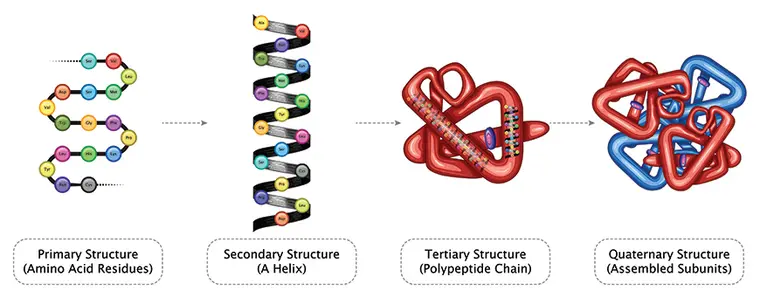
Levels of protein structure
- Primary structure: the sequence of amino acids
- Secondary structure: an α-helix or β-sheet
- Tertiary structure: the protein's three-dimensional globule
- Quaternary structure: several polypeptide chains joined together
For example, haemoglobin is a protein with a quaternary structure: it is made of several globules and transports oxygen.
Denaturation: the breakdown of protein structure
Denaturation is the process in which a protein loses its three-dimensional structure.
It can be caused by:
- high temperature
- a change in pH
- chemical exposure
Denaturation is sometimes reversible if the primary structure is not damaged.
When food is heated (for example, when cooking meat), proteins denature, which makes them easier to digest, but they lose their biological activity.
The main functions of proteins
1. Structural
Collagen, elastin, keratin: strength and elasticity of tissues
2. Movement
Actin and myosin make muscles contract
3. Transport
Haemoglobin, albumins: carrying substances
4. Protective
Antibodies, fibrin, toxins
5. Regulatory
Insulin, growth hormone, calcitonin
6. Storage
Egg albumin, milk casein, plant seed proteins
7. Energy
1 g of protein → 4 kcal, used only as a last resort
8. Signalling
Membrane receptors: receiving signals
9. Catalytic
Enzymes speed up biochemical reactions
All enzymes are proteins, but not all proteins are enzymes
Author: Irakli Kenchoshvili / Tidanigym.ge
Copying without permission is prohibited.
✅ Sharing with a link to the source is welcome
Got a question? Message or call us
Tidani + is a gym at 4 Politkovskaya St., 300 m from the metro. Mon–Fri 09–22, Sat–Sun 09–18.