What anabolism, catabolism and metabolism are
· 2 min
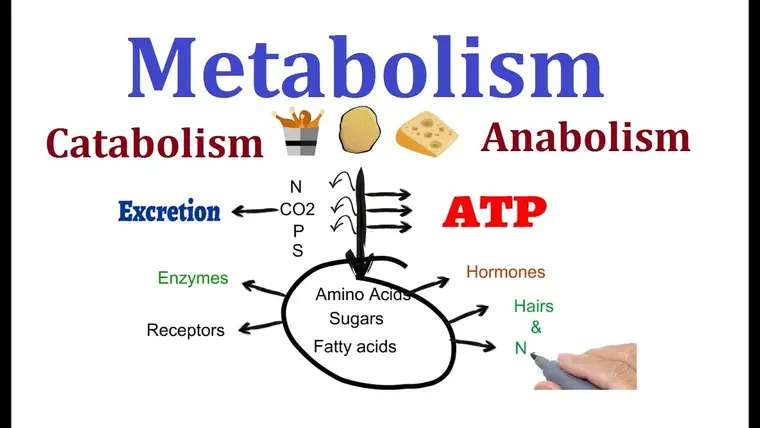
Metabolism is the sum of all the chemical reactions that take place in a living organism to keep it alive. Through these processes the body gets energy, builds its own tissues, regulates temperature and heart rate, and keeps every vital function working.
The body needs energy all the time, both at rest and during physical activity.
Metabolism is divided into two interconnected stages: anabolism and catabolism.
➤ Anabolism
Anabolism covers all the processes aimed at synthesising new, complex substances. In these processes the body uses energy (mainly ATP) to build complex structures from simple molecules.
Anabolism is often called constructive metabolism or assimilation.
Examples of anabolism:
- building proteins from amino acids
- growth of muscle tissue
- production of hormones and enzymes
- storing glycogen and fat reserves
- repair of cells and tissues
Catabolism
Catabolism is the opposite of anabolism. In it, complex organic substances are broken down into simple compounds, releasing energy. The main form of this energy is ATP (adenosine triphosphate).
Catabolism is also called energy metabolism or dissimilation.
Examples of catabolism:
- breaking carbohydrates down into glucose
- breaking fats down into fatty acids
- breaking proteins down into amino acids
It is important to understand that catabolism is not a “bad” process. On the contrary, without it the body could not get the energy it needs to live and to carry out anabolic processes.
How anabolism and catabolism are linked
The energy released by catabolism is used:
- to create new cells
- to repair tissues
- for muscle growth and hormone synthesis
In other words, catabolism and anabolism cannot exist without each other: they are two inseparable sides of metabolism.
How metabolism works step by step
- Proteins, fats and carbohydrates from food are broken down into simple molecules by the digestive system.
- The resulting building material is carried to the cells by the circulatory system.
- The energy released by breaking down nutrients is stored as ATP.
- From amino acids, fatty acids and simple sugars the body assembles its own proteins, fats and carbohydrates.
- Excess energy is stored as glycogen in the liver and muscles, and fat in the subcutaneous fat tissue. When needed, these reserves are used as a source of energy.
It is thanks to these reserves that a person can go without food for some time.
Author: Irakli Kenchoshvili / Tidanigym.ge
Copying without permission is prohibited.
✅ Sharing with a link to the source is welcome
Got a question? Message or call us
Tidani + is a gym at 4 Politkovskaya St., 300 m from the metro. Mon–Fri 09–22, Sat–Sun 09–18.