Back extension (hyperextension)
· 2 min
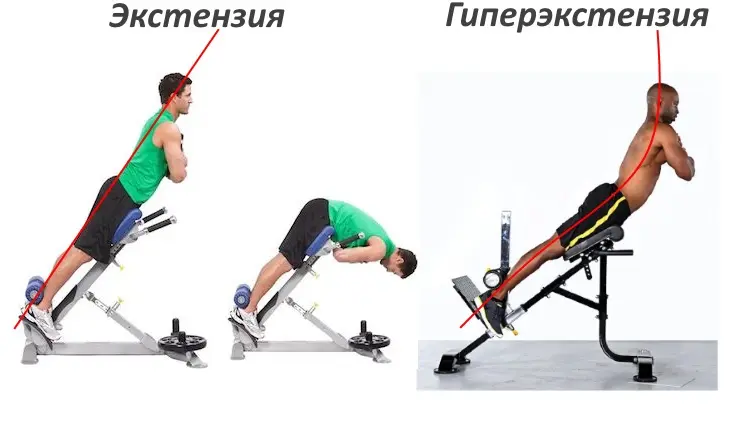
This exercise is widely known as the “hyperextension”, but biomechanically it is in most cases a spinal extension: straightening up to a neutral position.
Hyperextension means arching back beyond neutral, which is not recommended.
The exercise is effective for strengthening the spinal erectors, the glutes and the hamstrings.
Technique
Starting position
- Adjust the machine so that the pads support the upper third of your thighs, just below the hip joint.
- If the pad is too low, the load shifts onto the hamstrings.
- If it is too high, the risk of overloading the lower back increases.
- Place your calves under the ankle support.
- Keep your torso neutral (do not round your back or arch it too much).
- Arms crossed over the chest or behind the head (the harder version).
- Knees slightly bent to reduce excessive tension in the hamstrings.
- Feet parallel.
Execution
As you inhale, slowly lean forward by bending at the hips.
Keep your back neutral.
Lean down to roughly 60–90°, until you feel a stretch in the hamstrings, but without rounding your back.
As you exhale, straighten your torso and return to the starting position, only up to a neutral line.
Do not arch back at the top.
Perform the movement slowly and under control.
🔹 Adding load
- A plate or dumbbell held on the chest
- Resistance band
- Single-leg version (for advanced trainees)
Muscles worked
Primary
- Spinal erectors
Secondary
- Gluteus maximus
- Hamstrings
- Deep core stabilisers (working isometrically)
Important notes
- The muscles are stretched at the bottom, but this has no significant therapeutic “decompression” effect on the spine.
- Rounding the back increases the load on the discs and is not recommended for beginners.
- The movement should come from the hips, not from the lower back.
Variations
- 45° back extension machine (the most common)
- Horizontal machine (requires more control)
- Free version on a bench with a partner's help
- Glute-focused version, with a short range of motion and active hip extension
Common mistakes
❌ Arching the lower back too far at the top (true hyperextension)
❌ Rounding the back at the bottom
❌ Jerky movement using momentum
❌ Too much weight without control
When to include it in your programme
Best used
- in the middle or at the end of a workout
- as an accessory movement after deadlifts or squats
- or as a step in learning the hip hinge technique
Very exhausting sets are not recommended at the start of a workout if you plan heavy compound lifts afterwards.
Similar exercises
- Good morning
- Romanian deadlift
- Deadlift
Author: Irakli Kenchoshvili / Tidanigym.ge
Copying without permission is prohibited.
✅ Sharing with a link to the source is welcome
Got a question? Message or call us
Tidani + is a gym at 4 Politkovskaya St., 300 m from the metro. Mon–Fri 09–22, Sat–Sun 09–18.