Back muscles: structure and function
· 2 min
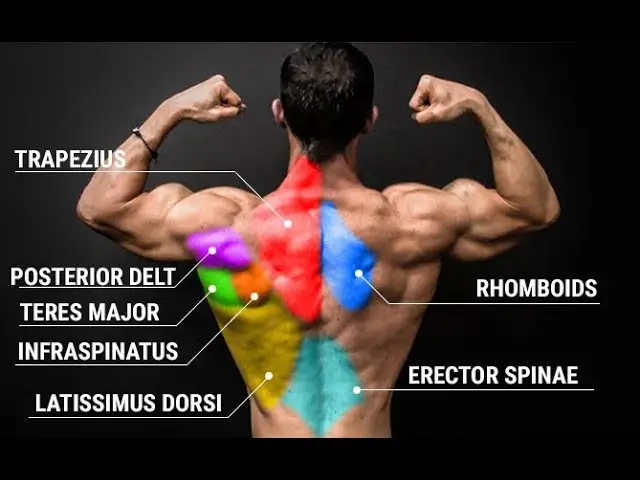
The back muscles are one of the strongest muscle groups in the body. They take part in moving the shoulder and shoulder blade, stabilising the spine and holding good posture. Among the superficial back muscles, the most important are the latissimus dorsi and the trapezius.
Latissimus dorsi
The latissimus dorsi is a large, fan-shaped muscle that covers the middle and lower back and makes up most of the back's width.
The muscle originates from
- the lower thoracic vertebrae (T7–T12)
- the lumbar vertebrae
- the thoracolumbar fascia
- the iliac crest
- the lower ribs
Its tendon attaches to the humerus.
Main functions
The latissimus dorsi performs several important movements:
- shoulder extension (moving the arm backwards)
- shoulder adduction (pulling the arm towards the body)
- shoulder internal rotation
- lifting the body when the hands are fixed (for example, in pull-ups)
In fitness practice, different fibres of the lats are engaged differently depending on the direction of the movement.
Exercises
- Lat pulldown
- Pull-ups on a bar
- Seated cable row
- Bent-over barbell row
- One-arm dumbbell row
- Pullover
These exercises develop both the width and the thickness of the back.
Teres and infraspinatus muscles
- Teres major
- Teres minor
- Infraspinatus
These muscles originate on the shoulder blade and partly attach to the humerus.
Functions
- stabilising the shoulder
- rotating the shoulder
- controlling shoulder movements
Teres minor and infraspinatus are especially important because they are external rotators of the shoulder and belong to the rotator cuff, which protects the shoulder joint from injury.
Trapezius
The trapezius is a large superficial muscle that covers the upper back and the back of the neck.
The muscle originates from
- the occipital bone
- the cervical vertebrae
- the upper thoracic vertebrae
Its fibres attach to
- the collarbone
- the shoulder blade
The trapezius has three parts
Upper part
Originates at the base of the skull and attaches to the collarbone.
Functions
- raising the shoulders
- rotating the shoulder blade upwards
- stabilising the neck
Middle part
Originates from the upper thoracic vertebrae and attaches to the shoulder blade.
Function
- pulling the shoulder blades together
Lower part
Originates from the thoracic vertebrae and attaches to the lower part of the shoulder blade.
Functions
- lowering the shoulder blade
- stabilising the shoulder blade
- helping to rotate the shoulder blade
Exercises for the trapezius
- Shrugs
- Reverse fly
- Face pull on a high cable
- Bent-over barbell or dumbbell row
Conclusion
The back muscles play an important role in movement, strength and stability. Developing them properly not only improves your physique but also helps maintain good posture and prevent injuries.
To develop the back fully, training should include both vertical pulling and horizontal pulling movements, which build both width and thickness.
Author: Irakli Kenchoshvili / Tidanigym.ge
Copying without permission is prohibited.
✅ Sharing with a link to the source is welcome
Got a question? Message or call us
Tidani + is a gym at 4 Politkovskaya St., 300 m from the metro. Mon–Fri 09–22, Sat–Sun 09–18.